

By J.S Okello, PhD(c) Palme Research and Training Consultants | April 2026
Rejection from a peer-reviewed journal is rarely a surprise to the editor who issues it. By the time a manuscript reaches the reviewers, an editor has already made a provisional judgement at the desk stage. The research may be sound. The data may be credible. But if the abstract overstates the contribution, the methods section leaves key choices unexplained, or the target journal is simply the wrong fit, the manuscript will not survive that first ten minutes of editorial scrutiny. The researcher will wait six to sixteen weeks for confirmation of what the editor knew at the start.
This problem is not confined to early-career researchers, though it hits them hardest. It cuts across institutions, disciplines, and career stages. What differs is access: researchers at well-resourced universities in high-income countries have colleagues, supervisors, and writing centres who will read a manuscript before it goes out. Researchers in Kenya, Uganda, Tanzania, and across the broader Global South largely do not. The pre-submission review infrastructure that distinguishes a competitive from a non-competitive submission simply does not exist for most of them.
PeerSim Pro is our response to that gap.
What PeerSim Pro Does
PeerSim Pro is an AI-powered manuscript review and revision system built for academic researchers who need structured, expert-level pre-submission feedback before submitting to a peer-reviewed journal. It operates in four stages, each covering a distinct phase of the publication journey.
The first stage is free. A researcher submits their abstract and manuscript details, and PeerSim Pro runs three expert reviewer perspectives: a Field Analyst who establishes whether the disciplinary framing is coherent, an Editor-in-Chief who assesses journal fit, novelty, and significance, and a Methodology Reviewer who audits the research design against the conventions of the declared framework. The output is a partial score out of 45, a desk-reject risk rating, and a prioritised list of the three most critical issues the manuscript faces. No payment is required.
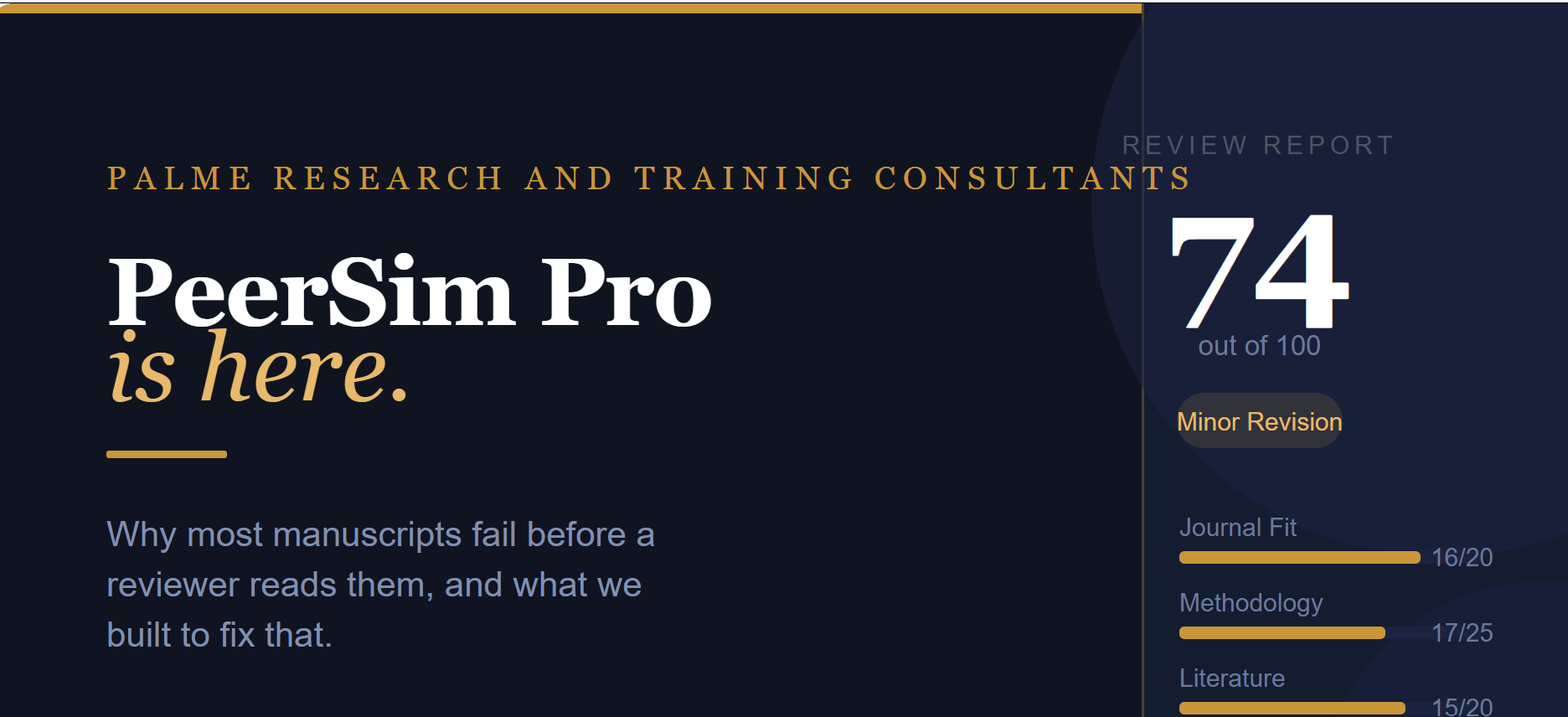
Researchers who want the full picture proceed to Stage 2. This adds four additional reviewer perspectives, including a Domain Reviewer who tests the currency and completeness of the literature review, a Perspective Reviewer who assesses cross-disciplinary clarity and practical implications, and a Devil’s Advocate reviewer who applies a ten-rule Critical Sparring Protocol to the manuscript’s central argument. The sparring protocol surfaces the strongest possible counter-argument to the author’s thesis, assigns confidence scores to every identified flaw, and produces a numbered Blind Spot Summary that the author can work through before resubmission. A six-phase Manuscript Integrity Check then audits every reference for existence, DOI resolution, citation consistency, quantitative claim accuracy, interpretive claim anchoring, and APA 7 compliance. The full output is a 100-point score, an editorial decision mapping (Accept, Minor Revision, Major Revision, or Reject and Resubmit), and a Revision Roadmap of up to fifteen prioritised actions.
Stage 3 takes the Roadmap and executes it. The manuscript is rewritten section by section, with every new citation sourced through a live-verified evidence pipeline that requires DOI confirmation before any reference enters the text. This eliminates the citation hallucination problem that has made AI-assisted academic writing unreliable. The delivery includes a revised manuscript, an updated APA 7 reference list with hyperlinked DOIs, a Zotero-compatible RIS export, a Revision Summary table, and a Final Citation Report with an integrity status of Clear, Conditional, or Hold.
Stage 4 is the most technically demanding. It activates after a manuscript has been submitted to a journal and actual peer reviewer comments have been received. The researcher uploads the reviewer comments document, whether a Word file with tracked changes, a PDF, or a separate letter, alongside the original manuscript. PeerSim Pro extracts every comment, assigns each a reference code, classifies it as a Major Concern, Minor Concern, Technical Correction, Clarification Request, or Out of Scope, then runs a targeted literature search to find two to three peer-reviewed sources that address each concern. The manuscript is then fully rewritten to incorporate all accepted revisions, with every change traceable to the specific reviewer comment that prompted it. The final package includes a point-by-point response table and a formal response letter addressed to the editor, ready for submission.
Who This Is For
The primary users of PeerSim Pro are PhD students and early-career researchers preparing their first journal submissions, independent researchers without institutional pre-submission review support, research supervisors who need a consistent and documentable quality standard for reviewing student manuscripts before recommending them for submission, and research consultants and NGO researchers conducting applied studies in public health, education, environmental science, and social policy.
PeerSim Pro was built with LMIC researchers explicitly in mind. The journal fit reference table includes African Journal of Primary Health Care, Global Health: Science and Practice, Health Research Policy and Systems, and Frontiers in Public Health alongside the higher-profile titles. The Domain Reviewer perspective specifically tests whether LMIC-focused manuscripts engage with LMIC-specific literature rather than importing findings from high-income country contexts without acknowledging the transferability limits. This is a gap in most generic manuscript review tools, and it matters: a reviewer at Implementation Science or The Lancet Global Health will notice immediately if an East African study’s Discussion draws primarily on North American or European evidence without contextualising it.
The tool is also designed for researchers working across health systems, implementation science, systematic reviews, qualitative studies, and mixed-methods designs. The Methodology Reviewer applies different frameworks depending on the declared design: PRISMA 2020 for systematic and scoping reviews, CASP and CERQual for qualitative synthesis, Cochrane Risk of Bias and ROBINS-I for quantitative studies, and CFIR, EPIS, and RE-AIM for implementation science manuscripts. Researchers do not need to specify which applies; PeerSim Pro infers it from the intake information.
How the Process Works in Practice
A researcher submits their manuscript through the PeerSim Pro page on the Palme Research website. The submission form collects the manuscript type, target journal, a paste of the abstract (for Stage 1) or a full file upload (for Stages 2, 3, and 4), and any special instructions.
We run the review within our AI research environment and email the full report to the researcher’s inbox within 24 hours for Stages 1 and 2, and within 48 hours for Stages 3 and 4. The researcher does not need a Claude, ChatGPT account, any technical setup, or familiarity with AI tools. They submit a manuscript and receive a structured report.
Stage 4 is also available as a standalone service for researchers who received peer reviewer comments from a journal submission that predates their use of PeerSim Pro. The tool does not require continuity across stages.
On the Question of AI and Academic Integrity
This question deserves a direct answer.
PeerSim Pro does not write a researcher’s argument for them. It reviews what the researcher has written, identifies where the argument is weak, where the evidence is missing, and where the framing will not survive scrutiny, and it shows the researcher exactly what to address before submission. The Stage 3 revision incorporates only changes that emerge from the Stage 2 review findings, and every revised passage is marked so the author can see what changed and why. The evidence pipeline requires live DOI verification for every new source, which means the tool cannot fabricate references or confuse papers.
The practical effect is that PeerSim Pro functions like a thorough pre-submission colleague review, the kind that researchers at well-resourced institutions receive as a matter of course and that researchers elsewhere largely do not. Access to that kind of feedback before submission is not a shortcut but a structural advantage that has always existed, concentrated at a small number of institutions.
The Stage 4 peer review response service is similarly transparent. Every change to the manuscript carries a reference code pointing to the specific reviewer comment that prompted it. The point-by-point response table accounts for every comment, including those declined, with evidence-anchored justifications. Editors can and do check these things.
Pricing and Access
Stage 1 is free. Stages 2 and 3 each cost KES 2,000 per manuscript. Stage 4 costs KES 3,000 per manuscript. Payment is per submission, not per month. A researcher who needs only the free Stage 1 analysis and chooses not to proceed further pays nothing and receives a partial but actionable review.
For research centres, schools of public health, NGOs, and universities running multi-paper publication programmes, we offer institutional pricing. Contact us at palme7447@gmail.com or WhatsApp 0729 143 536 to discuss batch arrangements.
A Note on Why We Built This Here
Palme Research and Training Consultants is a Nairobi-based research consultancy. We work with PhD students, early-career researchers, and public health practitioners and social research workers across Kenya, Uganda, Tanzania, and the broader East African region. We see, regularly, the gap between what a manuscript could be and what it becomes when it goes to a journal without structured pre-submission feedback. We also see the cost: months of delay, repeated revision cycles, and, in some cases, abandonment of papers that had genuine findings worth publishing.
PeerSim Pro was built from within that context, not from outside it. The LMIC framing is the reason the tool exists.
Researchers interested in submitting a manuscript for Stage 1 analysis can do so at no cost through the PeerSim Pro page on this website. The form is straightforward. The report will be in your inbox within 24 hours.
J.S Okello is a PhD researcher and the founder of Palme Research and Training Consultants, based in Nairobi, Kenya. His work focuses on implementation science, health systems research, and research capacity development in East Africa.
For manuscript submissions, institutional pricing enquiries, or general questions about PeerSim Pro, contact palme7447@gmail.com or WhatsApp 0729 143 536.